Illior Empire
- Capital: Illior
- Government: Emperor Yorick Maldred Augustus Tarquinius and the Senate
- Population: about 3,000,000
- Languages: Central Imperial, Southern Imperial, Northern Imperial, Elvish
- Motto: “Illior’s destiny is to rule the world”
- Army: about 120,000, including the watch and the militia called up during mobilization
- Money: the Illiorian crown — the world’s standard of coin weight and fineness; denominations of 1 and 5 in copper, 10 and 50 in silver, 100 and 500 in gold, 1,000 in platinum
- Stylistic features: gold and yellow in clothing and in the colors of houses. Monumental architecture with colonnades, bas-reliefs, and statues. References: the Roman Empire, Napoleon’s empire.
- Video: YouTube link
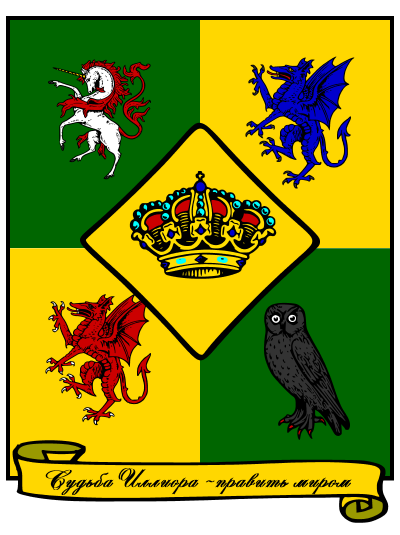
The Illior Empire is a huge country that has existed for about eight hundred years. In many ways, it is the Empire that shaped the history of modern humanity for centuries. In the 500s, most of the continent known as the Eastern Lands was subject to the emperor of Illior. More than five hundred years have passed since then, many former provinces have become independent states, but the Empire is still very strong. It is the most densely populated and urbanized country in the world. It is home to the headquarters of many guilds whose power extends all over the world. Imperial goods are in demand everywhere, the flow of cargo into and out of the Empire never dwindles, which means the population grows and gets richer, making the country stronger. However, things are not as rosy as they might seem at first glance: for more than a century now the country has been torn apart by internal contradictions and crises.
Structure
Administrative and Political Structure of the Illior Empire
- Estates. The Empire has five estates:
- The high aristocracy — members of the seventeen Great Houses that founded the city of Illior more than a thousand years ago. This is a very thin layer that owns enormous resources and power and has the greatest rights before the law.
- The middle and lower aristocracy. This estate includes the cadet branches of the Great Houses, as well as less ancient houses that, as a rule, received their status in the service of more noble aristocrats.
- Ordinary citizens of the Empire — those who have no titles, but have rights and duties toward the state. The bulk of the population belongs to this estate.
- Non-citizens — foreigners permanently residing in the territory of the Empire, and freed slaves. They are effectively excluded from political life, although with money they can become citizens or influence decisions through other people.
- Slaves. They have no rights whatsoever and are considered property.
- Citizenship. Only citizens have political rights. One becomes a citizen by right of birth into a citizen’s family, after fifteen years of service in the imperial army, or by receiving citizenship as a gift from a Great House or from the emperor himself. In addition, citizenship can be officially bought: the price depends on the prefecture and starts at five thousand gold per family, and the decision to grant citizenship is made by the local court. The imperial bureaucracy keeps a register of citizens and issues the corresponding papers. Forging documents confirming citizenship is considered one of the gravest crimes.
- Rights and duties. Although by law the estates are not equal, all citizens of the Empire can take part in the political life of the country and be elected or appointed to various offices. The main duties of citizens are paying taxes, serving in the army in case of mobilization, and taking part in jury trials (if the lot falls on them).
- Democracy. The Illior Empire is a constitutional monarchy: the emperor doesn’t have absolute power, but rules together with the Senate. The Senate has the right to veto the emperor’s laws, and vice versa: in 1005, the current emperor secured for himself the right to veto the Senate’s decisions. Since the revolution of 817, besides the representatives of the Great Houses, the Senate seats a people’s deputy elected by universal vote. In addition, every city has a city council and a mayor, who are also elected by the local residents. Above them stand the senates of the prefectures, which are formed from representatives of the city councils. These are legislative bodies, but the prefect, appointed by the emperor, has the right to veto any of their decisions: the senate governs as long as the prefect is satisfied.
- Prefectures. The Empire is now divided into four prefectures, each with its own cultural and geographical features. Each prefecture is a state within the state: with its own senate, local interpretations of the laws that may differ slightly, and, in the case of the Run Prefecture, a second official language as well.
- Courts and law. The Empire has an ancient judicial tradition: ordinary citizens can become judges at almost all instances, and the institution of the jury is well developed. Imperials love to sue each other, sometimes over trifles. As a rule, cases are heard openly, and attending trials is one of the favorite pastimes of the country’s inhabitants.
- Slavery. Slave-owning is an important part of the Empire’s economic life. The price of a slave starts at about a thousand gold for an untrained person or one of little use for work, and goes up to tens of thousands for experienced craftsmen. For scale: an ordinary peasant earns about three hundred gold a year, so a slave is a very expensive purchase for his family. Slaves have no rights whatsoever and are formally considered property. Society condemns abuse and torment of slaves beyond what is necessary to keep order, although the law doesn’t prosecute them. An owner has the right to free a slave, but is obliged to announce it publicly (this usually happens on Thursdays in squares and arenas). Citizens of the Empire who have fallen into slavery for debt stand apart. Their families can’t be separated, and they themselves can’t be sold abroad. In addition, such a slave can buy their freedom if they manage to get the necessary sum, or go free if the court finds that they have worked off their debt.
Society
- Religion. Most citizens of the Empire worship family guardian spirits and ancestors, whose altars are in every home. Twice a year, on the days of the spring and autumn equinoxes, great festivities are held throughout the Empire. More details are in the article on the Ancestors’ Cult. Cults that practice human sacrifice are banned in the Empire; in the past, followers of the Church of Cuthbert were also persecuted. On the whole, imperials are not very religious and see the Ancestors’ Cult more as a social tradition than as a religion.
- Suffrage. Institutions of popular rule have existed in the Empire since the day it was founded, and elections have long since become part of the culture. Voting, campaigning for your candidate, and running for office yourself is fashionable, and society encourages it. On voting days, cities hold festivals. In addition, it is customary for a newly elected official to do something good for the city at their own expense: repair a road, put up a new building, or, for example, stage fights in the arena. So the festivities often go on for weeks after the votes are counted.
- Riots. The people of the Empire often take to the streets to express their discontent. The occasion can be new taxes, the defeat of a favorite gladiator, an unfortunate statement by a local official — anything at all. Such demonstrations and small riots happen everywhere and have long since become a tradition. As long as the protesters don’t come out personally against the emperor and the Senate and don’t do the city too much harm, the authorities limit themselves to dispersing the crowd without bloodshed. However, riots aren’t always harmless: over its history the Empire has lost many regions, and the unrest in the capital in 817 noticeably weakened imperial power.
- Guilds. Guilds as independent and powerful commercial organizations first appeared in the Empire. Many of them have hundreds of years of history, and their power knows no state borders. In the Empire, guilds are everywhere, and people’s daily lives are closely tied to them: whole families work for guilds, from generation to generation. A guild flag or a decoration with its symbol on a private house is a common sight. Guilds, as a rule, have their own holidays and public festivities, their own heroes and songs dedicated to them. Belonging to a guild is almost a second citizenship: it gives opportunities, but also imposes restrictions.
- Arenas. Every city of the Empire has an arena or at least an amphitheater. Since ancient times, the Illiorians have loved spectacles and public performances. Politicians who want to win the love of the people invariably stage games at their own expense and perform before the public themselves. Chariot races and gladiatorial fights are popular in the Empire. Among gladiators and charioteers there are slaves, free people, and even aristocrats. For a slave, the love of the public is a sure path to freedom. Gladiators rarely die: fights to the death, as a rule, are staged only on major holidays. Every fight is a whole theatrical performance that acts out stories from the Empire’s past and present. Gladiator schools and teams of charioteers have many fans, who often fight among themselves. In the arena you can meet anyone, from members of the imperial family to the lowliest beggar.
- Slaves. Slaves are not only an important part of the economy, but also an integral part of imperial everyday life. Every family of even modest means has at least one slave. Domestic slaves often become almost members of the family and, even after being freed, continue to serve their former masters, now for pay. In recent decades, the idea that slaves are people too has been heard louder and louder in society. Whole associations have appeared that buy slaves and set them free, or refuse on principle to buy them and preach equality.
Relations with other countries (click to expand)
How the average inhabitant of the Illior Empire regards other countries.
- Bastion Union: Fools! They don’t want to be a protectorate of the Empire. Sooner or later our legions will take their fortresses, so they’d better surrender peacefully: resistance is futile.
- Slavetraders’ Coast: Good live goods are taken there, which the Makharatkha merchants bring us. Our colony was once in those parts, and perhaps one day imperial flags will rise there again.
- Vishnevodskoye Principality: Cursed separatists! They wanted to raise the dead so badly that they broke away from the Empire, along with all the riches of the Silver Mountains. The day will come when these lands are ours again.
- Principality of Zalessk: Barbarians and descendants of criminals. Sometimes they find amusing trinkets in the swamps, but on the whole they are useless and uninteresting.
- Principality of Igni: A powerful southern country. Sooner or later the Empire will again meet it on the battlefield, as it did centuries ago. We don’t understand and don’t like their ways and customs.
- Principality of Enforis: Much binds us to Enforis: our imperial house is related to them, although nothing good came of that union. We even fought them once. We regard this country with suspicion: it seems they’re forever plotting something. They’re not to be trusted.
- Colonial Rojo: It’s too far away; we know little about them.
- Colonies of Makharatkha: It’s too far away; we know little about them.
- Kingdom of Gross: A former part of the Empire, and many of us feel at home there. The Grossians are close to us in spirit and culture, and we are bound by close ties of trade and kinship.
- Kingdom of Zanra: Some of us hate Zanra for its rebellion against the Empire and the deaths of thousands of our people who tried to put down the uprising. On the other hand, that was long ago, we are bound by trade, and our imperial house is closely related to their royal family. Most likely, in the near future Zanra will become part of the Empire again, without any wars or upheavals. Although their traditions have strayed far from the imperial ones, and their bureaucracy would drive anyone mad.
- Kingdom of Rojo: Rebels who never managed to live properly without the Empire. Their independence was a mistake. Establishing a protectorate over Rojo was a wise decision of our emperor. Soon the locals will understand that being part of the Empire is a blessing.
- Land of Oases: We know almost nothing about this country. It seems some barbarians live there.
- Makharatkha: An ancient and powerful city-state. Their merchants are frequent guests in our parts. Of course, like all hucksters, they’d sell their own mother, but still, you can do business with them.
- Elka’s Oligarchy: We know little about these distant islands. It seems our colony was there, and we have relatives there.
- Archdemon’s Plateau: Untamed, inhospitable barbarian lands. All we know is that decent slaves are brought from there.
- Republic of Drinrog: Cursed traitorous hucksters! They got their independence and now dream only of humiliating the Empire. And we’re forced to trade with them, too. Drinrogians can never be fully trusted!
- Dragons’ Country: Our ancestors and allies: no wonder there are two dragons on our coat of arms. When they visit our cities, it’s a holiday for us! It’s a pity it happens very rarely.
- Ethel: The elves are our ancestors too: the unicorn on our coat of arms is the sign of one of the elven princely houses. Alas, they have grown very distant from humans. Speaking Elvish is refined and aristocratic, and knowing their ballads is a sign of good taste.
Regions and Cities
Illior Prefecture
Detailed article: Illior Prefecture
A large, moderately fertile region with a very unevenly distributed population: about a million people live in the city of Illior, and only about two hundred thousand in the whole prefecture around it. So everything here is tied to the capital, where the government of the Empire sits.
- Farming. Almost all the land around the capital is taken up by small farmsteads and plots. Grapes and wheat are grown here and made right on the spot into wine and other drinks. The region can’t feed the overpopulated capital, and part of the grain is bought in Sark.
- Economy. The prefecture lies at the crossing of several trade routes, which bring it enormous income from tolls and trade. Otherwise, the region’s prosperity depends entirely on the capital.
- Entertainment. The capital of the prefecture (and, incidentally, of the Empire) has the world’s largest Imperial Arena, where grand tournaments and gladiatorial fights are held. Besides that, the city has taverns and brothels for every taste and purse.
Run Prefecture
Detailed article: Run Prefecture
There are at least thirty castles in the region, belonging to various aristocratic houses. Run is rich in iron, which is mined in numerous mines in the Forest of Horrors. In the north, Run borders the Prefecture of the Dead and the Vishnevodskoye Principality. The Vishnevodians regularly raid the borderlands, and dreadful creatures keep crawling out of the Forest of Horrors and the Prefecture of the Dead. So the locals are used to skirmishes: every settlement has a small militia, and the roads are constantly patrolled by government troops.
- Economy. The basis of the region’s economy is iron mining. Greyheld houses the headquarters of one of the most powerful guilds in the world — the Metallurgists’ Guild. A multitude of foundries and smithing shops produce weapons and other metal goods that go all over the world.
- Entertainment. The main pastime of the people of Run is hunting. Local huntsmen will organize an expedition after any beast.
Sark Prefecture
Detailed article: Sark Prefecture
More than one and a half thousand years ago, the main stronghold of the elves stood here — the fortress of Dagor. Of it, all that remains from those times is the name, borne by the present capital, and the ancient walls: the fortress has been rebuilt many times and now houses the prefect’s residence. The lands of Sark are very fertile; they say it is the legacy of the magic of the elves who lived here. The prefecture not only feeds the whole Empire but also sells food to other countries. A third of Sark’s population are non-citizen tenants who come here for the local soils.
- Economy. The region lives by farming and livestock breeding. Most of the native population lives off land rent. Besides that, Dagor stands on an ancient trade highway leading from north to south, to the Republic of Drinrog.
- Entertainment. Dagor is the gambling capital of the Empire. Wealthy landowners and gamblers from all over the world come here to blow their money in the numerous gambling houses.
Vilarin Prefecture
Detailed article: Vilarin Prefecture
This prefecture is strikingly different from the other regions of the Empire. There is only one large city here — the university city of Vilarin, standing amid dangerous, magic-soaked swamps, the legacy of the Great War. The emperor appoints a prefect here who formally rules the whole province, but actual power belongs to the rector of the Vilarin University of Magic. The rector is chosen democratically: the faculty and electors from the student unions take part in the election. However, rectors tend to live a very long time — the current one was elected thirty years ago.
The university was founded here back under the first emperor. The local land is steeped in magical energy and abounds in artifacts of past eras. Here even the weakest mage can cast far more powerful spells, which helps with studies. In addition, one of the university’s tasks is to study the anomalies and keep what happens in the region under control.
Most of the region is taken up by dangerous, almost impassable swamps. For simplicity they are called the Vilarin swamps, but connoisseurs of the land know that each stretch has its own name. Besides the university, there are other settlements here, but very few inhabitants live in them. A noticeable part of the population lives in the south of the prefecture, near the border with Zanra. Farming is impossible here, but hunting thrives: the locals go into the forests and swamps after ordinary game and after monsters. For example, giant frogs live in the swamps, and their meat is prized by gourmets. In addition, many alchemical herbs and trees grow here that are able to survive near powerful sources of magic.
History
In Brief
From the 70s on, Maldred the Conqueror, the progenitor of the Illiorian imperial family, here by arms, there by diplomacy, gathered an alliance of city-states in the Eastern Lands, which in those days were not yet so dangerous. At the end of his life, in 206, Maldred transformed the Illior Union into an empire. Since then the Empire has known rises and falls: some emperors tried in vain to push back the borders, others noticeably improved the roads and cities. There were riots and dynastic crises, but one way or another the population of the Empire, as of the whole world, grew, and the horrors of the Great War receded further and further into the past.
During the Time of Troubles, beginning in the 560s, the Empire is shaken by upheavals and loses vast territories. Rojo is the first to rebel: after seven years of war, in 567, it gains independence. After it, in 573 — though without bloodshed — another province, Gross, breaks away from the Empire. Against this backdrop, strange things are going on in the imperial family, and in 612 a revolt breaks out in Run, but the province is held.
In 672, a new misfortune befalls the Empire: a magical catastrophe occurs in the province of Arnost. The northern lands of the country become uninhabitable, and contact with the territories that will later become the Principality of Zalessk is cut off.
In 715–717, after long years of relative stability, the Makharatkha Plague sweeps the world. The densely populated Empire suffers from this magical disease perhaps more than anyone. Whole cities die out, and the country is struck by a severe crisis whose consequences are noticeable even three hundred years later.
In 777, another province rebels — Drinrog — and imperial power again can’t hold on to the rebellious region. Discontent with the authorities is brewing among the people, and the government responds by stepping up repressions.
In 817, a revolt breaks out in the capital itself. Its result is a sharp weakening of imperial power, a strengthening of the Senate, and the beginning of liberalization. Against the backdrop of the turmoil in the capital, Zanra declares independence, and in 818 the remainder of the Arnost Prefecture breaks away from the Empire, becoming the Vishnevodskoye Principality.
With that, the Empire’s misadventures came to an end. A relatively calm period began: for almost two centuries the emperors ruled with an eye on the Senate and didn’t dare seriously challenge the outcome of 817.
Everything changed under Emperor Yorick, who ascended the throne in 985. Relying on the love of the common people and loyal aristocratic houses, step by step he returns power to the throne: he pushes back the opposition, and in 1005 he obtains the right to veto the Senate’s laws. In 1004–1005 this becomes obvious to everyone. Intelligence accuses members of House Furia, longtime opponents of the monarchy, of treason, and the emperor tries them personally. Following the Second Igni–Rojo War, Yorick becomes the protector of Rojo, and the province that broke away more than four hundred years ago de facto returns under the Empire’s hand. Talk of restoring the old borders grows louder and louder.
In 1005, the country is ravaged by the fire plague. The disease claims many lives but eventually recedes — rumor has it that the emperor stopped it personally with the help of the ancient magic of the Founder’s Palace, and Yorick’s authority soars sky-high. That same year, at the height of the election campaign of Decimus Furius, head of the opposition house, the emperor declares an amnesty, and Decimus’s nephews are released from prison, and in the summer Decimus himself wins the election for mayor of the capital. Many see this not as a concession but as calculation: the emperor prefers to keep his opponents close.