Principality of Enforis
- Capital: Olifanor
- Government: an aristocratic republic — the elected Prince Amranduin I and the Senate
- Population: about 200,000
- Languages: Elvish, Central Imperial
- Army: about 8,000; in case of a major war, up to 60% of the population
- Money: any
- Stylistic features: light-colored mantles of light fabrics, and in cold weather woolen clothing, windbreakers, and sailcloth cloaks. The architecture is functional: wooden houses on stone foundations, and any building can easily be turned into a fortification when needed.

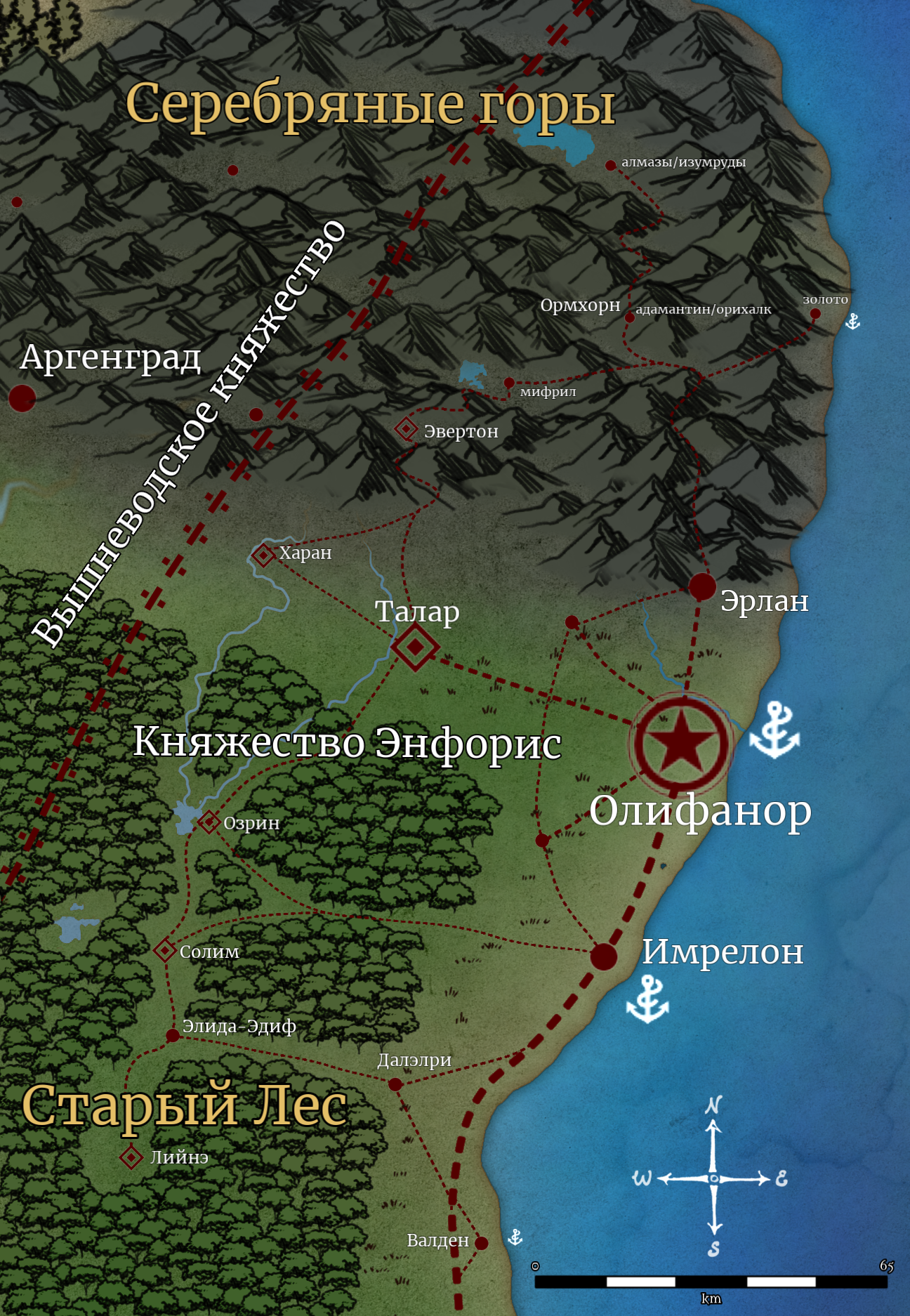
Enforis is one of the oldest states of Dedrel, founded by humans and elves. Despite the war with the Vishnevodskoye Principality, which hasn’t subsided for almost two centuries, Enforis holds almost half of the Silver Mountains, rich in precious stones and metals. Its overseas colony, Elka’s Oligarchy, formally remains part of the principality as well.
Structure
- Aristocratic republic. Although the country is called a principality, in reality Enforis is a republic with a property qualification for elections. The head of state is called the prince, but the prince, like the Senate and the heads of cities, is elected for ten years.
- Equality. All citizens of Enforis are equal before the law, regardless of origin and position.
- Citizenship. As in the Empire, Enforis has citizenship. Three citizens must vouch for someone who wants to become a citizen, and the applicant must pass an exam on the laws and an interview conducted by one of the ministers or even by the prince. Having passed all the trials, the new citizen swears an oath of allegiance to the principality and receives a magic amulet confirming citizenship. A petition for citizenship can be considered for years.
- Elections. To run for public office, a citizen must deposit a pledge in the treasury: prince — 10,000 gold, senator — 5,000 gold, mayor — 2,500 gold, member of a city council — 1,000 gold. Voting is paid too: the right to vote costs 100 gold.
- A nation in arms. All citizens whose health allows it undergo basic military training and are obliged to report to the assembly points at the prince’s call. So in a major war the state can put up to sixty percent of the population under arms.
- Progressive tax. The more a person earns, the more they pay into the treasury.
- Care for citizens. The treasury pays a pension to those who can’t support themselves and whom their relatives can’t keep. There are hospitals everywhere where any citizen is treated for free. Educational institutions that give both primary and higher education, including magical education, are free too.
- Ban on slavery. Slavery and the slave trade are forbidden in Enforis.
Society
- Elven blood. Enforis is closely tied to the elven state of Ethel by trade, alliance, and kinship. Enforisians often study in or visit Ethel, and in former times meeting an elf in Enforis itself was commonplace. This has left its mark on the local culture, which resembles the elven one: a contemplative view of life, care for nature, love of humanity.
- A sense of exceptionalism. The locals are considered arrogant snobs who set themselves above others. In many ways this is true: the Enforisians really are very different from other peoples and proud of their distinct identity, although open hostility toward other peoples is rarely met here.
- Sword and banishment. Centuries of skirmishes — first with undead and monsters, then with Vishnevodsk — forced the locals to study magic capable of countering necromancy. For the same reason the state has become very warlike: every home keeps weapons in case of war. This greatly helps the safety of streets and roads: robbery is known here only on the borders.
- Seafaring. For centuries the Enforisians explored the waters of the Dark Ocean, and it was they who discovered the Sunny Islands, previously known only from legends. A great deal in the life of the principality is connected with the sea. Being part of a ship’s crew standing against the elements is in this people’s blood. And so the country, standing against the dark waves of the Vishnevodians, is like a ship where everyone does their part of the work.
Relations with other countries (click to expand)
How the average inhabitant of Enforis regards other countries.
- Bastion Union: A very young state — a few castles against an incomparably greater force. We sympathize with them: we know what it’s like to live in eternal fear of attack.
- Slavetraders’ Coast: A real hell, and demons inhabit it. Whole cities live by trading people. They deserve complete destruction.
- Vishnevodskoye Principality: Cursed necromancers who have been at war with us for centuries. As long as this state exists, we are in danger. Though there are probably normal people among their ordinary inhabitants too.
- Principality of Zalessk: Unfortunate barbarians: first the Empire turned their lands into a prison, and then they were cut off from the world altogether. Many of them hire themselves out to Vishnevodsk and meet their end at the walls of Talar or our other cities. They are rude and uncouth, and it’s best not to deal with them.
- Illior Empire: How good that our ancestors didn’t join the Empire. For centuries we’ve watched it fall apart and its policy change from ruler to ruler. Some emperors fought us, others were friends, but a country with such customs can’t be trusted: the Vishnevodskoye Principality, too, was once part of the Empire. Now they are only trading partners for us, but we shouldn’t forget that the Empire is dangerous — a dislike of independent countries is built into its very nature.
- Principality of Igni: Talking with their traders can be very interesting: the culture of Igni is very ancient and strikingly different from ours. But they have bound themselves in the chains of male domination, and their rulers forever crave more power and land, which is why bloody wars happen. One has to be on guard with Igni — it’s hard to understand what’s on their minds.
- Colonial Rojo: The people from Rojo on the islands have changed a lot: they are freer and see the world more broadly. It’s a pity they keep slaves, otherwise we could do business with them, especially now that the Empire has gotten its hands on their lands on the continent. Their policy must be watched closely: one day this archipelago may become both a threat and an ally.
- Colonies of Makharatkha: The embodiment of everything our society condemns: slave trading, cruelty, lawlessness, and injustice. The most notorious wheeler-dealers from Drinrog, Makharatkha, and the Slavetraders’ Coast have settled here. They are sworn enemies of Elka’s Oligarchy, and therefore ours.
- Kingdom of Gross: They brew good beer in Gross! But they are too close to the Empire for us to be real friends. Too little binds us, and besides, they have slaves.
- Kingdom of Zanra: Having gained independence, this country has truly transformed itself. It’s pleasant to have such a neighbor, all the more so as it trades in useful inventions.
- Kingdom of Rojo: The Rojans are too hot-tempered and fickle, but honest and brave. Competing with them at sea has always been a pleasure. It’s a pity this country has such a bloody history, and now it has fallen under the Empire’s power again. If they didn’t divide people into the noble and everyone else and didn’t keep slaves, we would surely have become allies.
- Land of Oases: Barbarians squeezed between several great powers. Their fate is unenviable: not knowing the blessings of civilization, they become the prey of slavers, swindlers, and other rogues. However, some tribes have moral foundations that could serve as an example to other peoples.
- Makharatkha: A gathering of sea robbers, wheeler-dealers, and swindlers. We’ve been fighting them at sea for centuries, and this struggle will probably never end. Don’t trust the Makharatkhans — they will always betray you.
- Elka’s Oligarchy: Their independence is the natural course of history. These are still our lands, but we shouldn’t forget that their customs and ways differ from ours. More and more Enforisians sail across the ocean and find a new home on the islands. We have many relatives there, and nothing can break this bond now. But the oligarchic families have enormous power, and it corrupts them: their actions often cross every line. Our task is to instill our values in their society so that the Oligarchy doesn’t turn into yet another barbarian country.
- Archdemon’s Plateau: The allies made a serious mistake by not razing Asmodius to the ground and by leaving the former slaves to their fate. This land once threatened the whole world and will surely become a threat again. The inhabitants of the plateau are cruel, and many are proud of their demonic origin. What good can be expected from such people?
- Republic of Drinrog: These hucksters know what they want and know how to get it. It’s a pity that profit most often matters more to them than any principles and morals. We were allies once — who knows, perhaps those times will return.
- Dragons’ Country: Like our elven ancestors, we have always regarded the dragons with great respect. They are our longtime trading partners, and their love of precious stones will always bring us profit. Their wisdom and might are very great. It’s a pity they rarely visit our parts and don’t invite us to theirs.
- Ethel: The elves are our ancestors and kin; they helped build our cities and taught us. It is sad that in recent centuries they have grown so distant from us, but in the harbors of Ethel a warm welcome still awaits us.
Regions / Cities
Olifanor
A large port city on the shore of the Dark Ocean and the capital of the principality, founded back in −181. The headquarters of the Sun Lions guild is here.
Imrelon
The second-largest city of the principality, also on the shore of the Dark Ocean, south of the capital. One of the three cities that founded the principality in −81.
Talar
A fortress in the west of the country that protects the principality from Vishnevodsk. It was founded in the first centuries of the new era, when the skirmishes with the Vishnevodians began.
Ormhorn
A mining town in the Silver Mountains. In its surroundings some of the most expensive metals in the world are mined — adamantine and orichalcum, and in the neighboring mines mithral, gold, diamonds, and emeralds.
Erlan
A large mining town in the north of the country.
Afrimas
An overseas colony of the principality in the Horseshoe Islands, a former elven outpost from the days of the Great War.
History
In Brief
Enforis is one of the oldest states of Dedrel. Its capital, Olifanor, was founded before the end of the Great War by a human woman and an elf. The principality has always been close to the elves, and most of the locals have elves not far back in their ancestry.
For centuries Enforis was at enmity with the Vishnevodskoye Principality, where traditions of necromancy are strong. At first it was a dispute between two independent countries, then Vishnevodsk became part of the Illior Empire, but the skirmishes continued, now dying down, now flaring up again. Enforis even officially fought the Empire, although sluggishly. The war flared up with new force after Vishnevodsk gained independence.
Enforis supported many separatists — the Republic of Drinrog, the Kingdom of Zanra — and they, in turn, helped and still help Enforis in its struggle.
After the discovery of the Sunny Islands, Enforis faced two troubles at once: its inhabitants leaving for overseas, and the secession of the colonies, which became Elka’s Oligarchy.
To this day Enforis wages an endless war with Vishnevodsk, and many prefer to flee war and worry across the ocean. But as long as the principality holds its mines in the Silver Mountains, it will fight for its independence and its place in history.
During the Great War
- −181. The Founding of Olifanor. After the allies destroyed the demon fortress of Akrit in the Silver Mountains during the First Raid, people were drawn here: there had long been rumors of untold treasures at the foot of the mountains. People settled on the coast of the Dark Ocean, gradually moving north and northwest. In −181, a romance began between a settler named Quennid and the elf Adamar, who had led the First Raid and stayed in these parts to finish off the monsters and demons. Soon the two of them founded the city of Olifanor, the future capital of the principality. From the very beginning Olifanor was closely tied to Ethel, the base of the elves: according to the sources, up to half of its inhabitants at that time were elves. So as not to take risks traveling overland, a shipyard was built in the city — this is how the local tradition of seafaring was born.
- −86. The Death of Quennid. At the age of 120, the city’s founder Quennid dies; she had ruled the growing settlement together with her husband. Adamar, who is granted a much longer life, decides to continue ruling and to create a state, uniting under one power the surrounding settlements that had arisen over the last hundred years.
- −81. The Creation of the Principality. After five years of negotiations and many meetings of the local nobility, the Principality of Enforis is founded. It includes the cities of Olifanor, Imrelon, and Ormhorn, as well as many villages and mining settlements. Democratic procedures are built into the laws even then. Adamar wins the election that same year and becomes the first prince of Enforis. Having held power for the prescribed ten years, he steps down. Adamar’s further fate is unknown. Some say he sailed to Ethel, others that he lived for a long time in Enforis, hiding who he was, still others that he continued the war with the demons and fell in one of the battles. There are also those who assert that Adamar secretly rules the country to this day. None of the versions can be confirmed or refuted.
In the Imperial Era
- The 80s–170s. The First Skirmishes with Vishnevodsk. As the north of the continent becomes safer, the lands neighboring Enforis are also settled. Closer to the sources of the Lior, Vishnevodsk grows up; its inhabitants also mine precious stones in the Silver Mountains, only in their western part. In 85, the chronicles of Enforis first mention attacks by the Vishnevodians, and the skirmishes don’t stop for almost another century. The Vishnevodians unabashedly make use of necromancy and of artifacts left over from the demons who once inhabited these places. The disputes are usually over the foothills suitable for farming or over rich deposits in the mountains. At the same time Enforis founds several fortresses — Everton, Talar, and Kharan.
- 175–176. The Pacification of Vishnevodsk. After a major battle on the border over a rich adamantine deposit, the indignant Enforisians turn for help to the elves, who by that time (the 170s) had grown very distant from humans, and there were few elves left on Dedrel anyway. The elves, in turn, turn to the new great power on the continent — the Illior Union of Maldred the Conqueror. In 176, Maldred’s son Gnaeus leads an army against Vishnevodsk. Enforis’s restless neighbors join the Illior Union and swear not to attack again.
- 181–184. The Monstrous War. The invasion of monsters that engulfed all the Eastern Lands doesn’t spare Enforis either. For three years dozens of monsters attack settlements and even dare to storm large cities. Half the principality is taken up by the Old Forest, and Enforis suffers very badly. Many forest villages are destroyed, and the settlements of Ozrin, Solim, and Liyne turn into well-fortified forts. It is then that universal military service takes shape in the country: all people, regardless of position, learn the art of war, and a huge quantity of weapons is distributed to citizens. The Monstrous War ends as suddenly as it began, but its legacy will rescue Enforis more than once in the future.
- 207. The Refusal of the Empire. After the creation of the Illior Empire, Maldred offers Enforis to join the new state. A nationwide vote is held in the principality, and the citizens decide they don’t want such a fate for themselves. They say the refusal causes no scandal in the Empire, but relations between the countries noticeably cool.
- 304. The Nightmare Under the Mountain. At the orichalcum deposit in Ormhorn, miners break into huge caves of unknown origin. The caves are inhabited by horrible creatures that attack the miners and nearly empty Ormhorn. They say these creatures lived there long before the demons and the First Humans; there is even a theory that the miners accidentally opened a passage into one of the fay worlds. The universal military training doesn’t fail: the attack is quickly repelled and contained. And yet it takes the army of Enforis a whole year to drive the creatures back under the mountains and seal all the passages.
- 320–452. New Raids. While a dynastic crisis is brewing in the Empire, the Rutilii, who have settled in Vishnevodsk, and the locals covertly attack the borders of Enforis. There is no official war between the Empire and Enforis, and the legions don’t take part in the skirmishes: the fighting is done mainly by mercenaries, undead, and subservient monsters. This time the attacks come along the whole border, not only in the Silver Mountains. Over almost 130 years Enforis loses several settlements, and the border shifts east. Only in 452 does Emperor Riklaeron finally heed the notes of Enforis and send the XVII Legion to the region, which stops the attacks for a time.
The Time of Troubles
- 553. Emperor Marcus takes the throne of Illior and, to everyone’s surprise, marries Enfina of Enforis, a descendant of Adamar and Quennid. For twenty years this marriage greatly improves relations between the countries: trade grows, and the highway from Garn to Olifanor is graveled.
- 571–610. After Marcus’s death, the throne is taken by his wife Enfina, who is endowed with a longer life. This goes against tradition, and anti-Enforis and anti-elven sentiment grows in the Empire. The situation worsens right up to Enfina’s abdication in 610, and since then relations between the two countries have never been the same.
- The 600s. While the Empire is shaken by riots, wars, and scandals, changes are under way in Enforis too. At the beginning of the 600s, politicians come to power who stake everything on armament and even talk about war with the Empire.
- 615. A group of Enforisian fanatics stages an act of sabotage in Argengrad, one of the large cities of the Arnost Prefecture. The city catches fire, and many civilians die. The prince condemns the arsonists and declares them wanted. The Empire sends the principality a note demanding the extradition of the criminals. They try to hush the matter up: society condemns the attack, but no one intends to hand its participants over to the Empire.
- 615–616. The Illiorian–Enforisian War. Empress Sylvia, who enjoys a terrible reputation, tries to win the people’s love and, in particular, declares war on Enforis. The aims of the war are unclear, and the army’s tasks are vague. The border XVII Legion crosses the border, fighting begins, but the forces of the Empire are clearly insufficient to take even the small cities of Enforis. Casualties on both sides are few: for the most part the armies simply hold their positions. In the winter of 616 the sides make peace.
- 623. An anti-imperial pogrom breaks out in Olifanor. The cause is the behavior of the ambassador, who, contrary to the laws of Enforis, brought his slaves into the country. Diplomatic relations are broken off for a time.
- 672. The Arnost Catastrophe. A huge part of the prefecture lies in ruins, and the surrounding lands are full of undead. A wave of refugees rolls all the way to the borders of Enforis, but the principality keeps no one and sends everyone on to the Zanra Prefecture. In Enforis they are convinced that the Vishnevodians, who had long practiced necromancy, were involved in the catastrophe. The undead that have overrun the forests and swamps around Vishnevodsk strengthen its army: experienced necromancers know how to subjugate zombies and other creatures. Enforis demands that Emperor Gnaeus II destroy the subjugated undead, but the emperor is incapacitated, and the demands settle somewhere in the chancellery.
- 698. The Discovery of the Sunny Islands. A seafarer from Enforis, Galan, stumbles by chance upon an island far to the east of the continent, names it Tilenakadi, and begins to explore the archipelago. Until then, the eastern islands were considered a semi-legendary sunken land, only occasionally mentioned in the chronicles of the dragons and the songs of the elves. That same year Galan discovers many islands. For the Enforisians, weary of the eternal threat from the west, the islands become a breath of fresh air: in just a few years tens of thousands of people move there and found trading posts for trade with the natives, and settlements. One of the first trading posts, founded in 699 — Elka — will later become the capital of the colonies. Colonization greatly spurs the principality’s economy: traders bring home a multitude of overseas goods.
- From the 700s. The border is restless: undead keep attacking settlements. The Empire throws up its hands, assuring that it has nothing to do with it, while Enforis blames the Rutilii for the attacks.
- 715–717. The Makharatkha Plague. These years become as black for Enforis as for all of humanity. About 80,000 people die in the principality, and the population has not recovered to this day.
- 719–720. Taking advantage of their neighbors’ dire situation, the people of Arnost, with the help of undead, seize several settlements of Enforis in the Old Forest, including the fortress of Liyne and the city of Elida-Edif. In effect, Enforis loses control over the south of the country: Dalelri and Valden are threatened with attack, and trade with the Empire stops. Enforis considers that it is at war with the Empire, while Illior assures that it is an internal affair of Enforis — a civil war. The Empire calls the people of Arnost fighting in Enforis volunteers. Most likely, the Empire really isn’t directly involved in the attack: it is the scheme of noble Vishnevodian families, who are gaining more and more independence.
- 720. Having recovered from the blow, Enforis spends colossal sums (after the plague, few people in the world are willing to fight) and hires several thousand fighters — both free mercenaries and members of the Grey Vanguard guild. Together with the regular army, within a few months they win back the captured cities. However, the Old Forest remains full of undead and dangerous.
- 726. For the first time in several centuries, the elves actively help humans: several detachments of Enforis undergo special training in Ethel to fight undead and mages more successfully. Fifteen years later, in 741, the trained fighters found the Sun Lions guild, which will become one of the most powerful guilds in the world.
- November 5, 730. The Day of Bright Swords. Elf-trained detachments attack from the air Artisium and Koshchin, cities of the Arnost Prefecture. Swift, deadly fights unfold in isolated estates before the eyes of many locals and travelers. Both detachments complete their mission and, having suffered losses, return home. Later the prince of Enforis declares that higher sentient undead were hiding in these cities, and that Enforis did its neighbors a service by destroying them. No retaliatory measures follow; moreover, Emperor Raloro soon officially thanks the principality for the operation. Relations between the countries noticeably warm, and trade gradually recovers.
- 777. Drinrog. A coup takes place in the Drinrog Prefecture, and the republic of the same name is born. Enforis plays a role in these events that proves fatal for the Empire. To seize power, the Drinrogian rebels hire the Black Riders guild, then based in the Port of New Hope on the Slavetraders’ Coast. The rebels’ own fleet, consisting mainly of merchant vessels, isn’t enough to quickly transport a huge number of mercenaries to Drinrog, and the Empire still had a fleet back then that would have had to be fought off. So the Drinrogians turn to Enforis for help. Remembering old grievances, the prince agrees and leases them the principality’s fleet, which accomplishes the task brilliantly. After the republic is proclaimed, Enforis is the first to recognize it and even concludes a mutual assistance treaty with it, essentially tying the Empire’s hands at sea: the outdated and small imperial fleet could have done nothing against the fleet of Enforis. The Empire is going through hard times, and there are no immediate consequences for Enforis.
- 781. The Island Crisis. A huge part of the colonies’ inhabitants, including the richest families of the Sunny Islands, did not have Enforis citizenship but paid taxes to Olifanor. For a long time this order rested on the principality’s powerful fleet, which in case of a revolt could simply cut the islands off from the continent and from each other. But by 781 the situation changes greatly. Not wishing to fight the metropolis, representatives of the richest families of the islands send an embassy to the capital with an ultimatum: at first they demand full independence. The negotiations drag on for about two months; two fleets are ready to go into battle at any moment, and trade freezes. In the end the colonies receive the status of a dominion of Enforis, and Elka’s Oligarchy comes into being. This decision of the prince and the Senate is far from welcome to all citizens: many politicians who took part in the negotiations lose the next election. But after that no one dares to return to the question of the colonies’ independence, let alone start a war.
- 817. After the coup in the Empire, another prefecture, Zanra, breaks away from it, and Enforis again supports the separatists, concluding many trade deals with them.
- 818. Its support for separatists comes back to haunt Enforis when the Arnost Prefecture becomes the Vishnevodskoye Principality. Having gained independence, the new country officially declares war on Enforis. Now the Rutilii, the ruling family of the principality, are restrained neither by the laws of the Empire nor by its leadership. Moreover, many noble families of Illior unofficially support the war with money and weapons: for all their disagreements with the Vishnevodians, the grudge against Enforis turns out to be stronger. The war goes on to this day. Enforis withstood the first blow, but its border is slowly, kilometer by kilometer, retreating east.
The New Age
- The 900s. The Mercenary Legion. The protracted war brings a new trouble: people leave their homeland and sail to the Sunny Islands, to Elka’s Oligarchy. Gradually, there simply aren’t enough soldiers left to defend some cities. The principality has to create the Mercenary Legion — a part of the army of Enforis recruited from foreigners willing to fight for money. It still costs the treasury considerable sums, but as long as Enforis holds the mines of the Silver Mountains, the principality can afford it.