Kingdom of Gross
- Capital: Bersan
- Government: noble democracy — the Sejm and the king it elects, Gustav III
- Population: about 400,000
- Languages: Northern Imperial, Central Imperial
- Motto: “This is our land!”
- Army: about 10,000
- Money: zloty; denominations of 1 and 5 in copper, 10 and 50 in silver, 100 and 500 in gold, 1,000 in platinum
- Stylistic features: in Gross it is customary to wear mustaches and beards and to decorate them. People dress unassumingly here, but often in the colors of their family coat of arms. For jewelry, the Grossians prefer silver and rare woods. The architecture is more practical than in the Empire: houses are mostly stone, with solid walls and narrow windows. There are many small fortresses and towers all over the country. References: Poland, Germany.
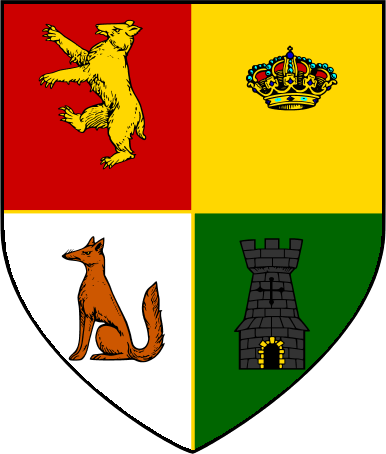
Gross is a kingdom in the center of the Eastern Lands, on the highway between the Illior Empire and Rojo. It is one of the oldest states of Dedrel: it was here, in 151, that a ruler took the title of king for the first time in human history. In 206, Gross voluntarily joined the Empire, and in 573 it seceded from it almost without bloodshed. Since then the country has been ruled by the Sejm — an assembly of all the noble houses — which elects the king itself. The Grossians are stubborn, brew the best beer in the world, and value their independence above all else.
Structure
Administrative and Political Structure of the Kingdom of Gross
- Estates. The kingdom has two estates: nobles and commoners.
- Democracy. The country is ruled by the Sejm and the monarch it elects. A member of any noble house or a member of another country’s royal family can become king. Formally, the king is elected for life, but he often abdicates — under pressure from the Sejm or for personal reasons. The Sejm seats representatives of all the noble houses entered in the Great Armorial. By a simple majority, the Sejm can veto a decision of the king.
- Rights. All political power is concentrated in the hands of the nobility. Commoners move freely around the country and work on the nobles’ fields and in their establishments as tenants, giving the owners part of their income. A noble has the right to use force against tenants with impunity, but murder is prosecuted by law. A commoner may buy land from its owner, but it won’t pass by inheritance: after the commoner’s death the land goes to the state, and the descendants have to buy it back again. As in the Empire, slavery is legal in Gross, although the fields are worked mostly by tenants.
- Finances. Every noble lives off their own lands. Taxes are few, so the treasury of Gross is very modest. When necessary, the Sejm raises money for specific needs.
- Cities. Because of legal confusion, only a few cities belong to specific noble houses. Most cities belong to the state as a whole, and many businessmen take advantage of this to dodge taxes and other obligations: the state machine is too weak and divided to keep track of everyone.
- Burghers. Many cities are effectively independent, and a new estate is gradually taking shape in them — educated craftsmen and merchants whose families are already more influential than some nobles. Seeing them, commoners abandon the land and move to the cities. All this creates tension in society.
Society
- Stubbornness. The Grossians are stubborn and ready to defend their point of view to the last. The endless squabbles in the Sejm and arguments in the taverns have long since become legendary. But that same stubbornness has more than once helped them hold out in hard times.
- Beer. Gross is famous for its breweries. The locals love beer dearly — as if to spite their eternal rivals from Rojo, who make wine. Beer is the national drink here: everyone drinks it, and many rites and holidays are tied to it.
- Fistfights. Nowhere are fistfights as popular as in Gross. The main peculiarity: local nobles see no shame in fighting themselves — against their equals.
- Independence. For many years the lands of Gross were a battlefield between rebellious Rojo and the Illior Empire. This raised in the locals a passionate love of independence and of the inviolability of their lands. The nobles of Gross take pride in the right to elect their king and in their personal autonomy.
- The forest. Back in imperial times, the Prefecture of Gross supplied the whole Empire with choice timber. To this day, nurseries of unique tree species survive here, which are said to have been growing almost since the time of the First Humans. The Grossians love forests, treat them with special respect, and take care of them.
- Religion. Gross is famous for its religious tolerance. As in the Empire, there is no official religion here; the worship of ancestral spirits is held in honor.
Relations with other countries (click to expand)
How the average inhabitant of Gross regards other countries.
- Bastion Union: These lands once belonged to us, but the Rojans took them away, and we fought over them for centuries. Now Rojo has been torn apart by turmoil, and a dangerous war is being fought at our border. Some believe we should help the Union fight off the Empire, or we’ll be next. Others believe we should stay neutral, keep out of other people’s fights, and above all not quarrel with the Empire. We have no single opinion.
- Slavetraders’ Coast: A terrible, inhospitable place with terrible, inhospitable people who constantly have to struggle to survive.
- Vishnevodskoye Principality: Restless necromancers — they’re forever a thorn in someone’s side. We don’t like necromancers: their magic is disgusting and dangerous. Fortunately, they live far away, and we have little to do with them.
- Principality of Zalessk: It’s a tragedy that they are cut off from the rest of the world. Many of our distant relatives live among them. We trade with them as best we can, but it’s very difficult.
- Illior Empire: Our closest allies and at the same time our most dangerous enemies. We were once part of the Empire and don’t want to lose our independence, and the Empire will never forget the past. Our capitals are too close to each other, and the border is too long, to even think of war. But we can’t let the Empire do whatever it pleases either. We are closely bound to the Empire by both trade and kinship.
- Principality of Igni: A powerful country with strange customs. For all our feuds, it’s fitting for Rojo to fight us, not overseas princes. Igni’s recent attack on Rojo outraged us.
- Principality of Enforis: A prosperous country, even though it wages an endless war with the Vishnevodskoye Principality. We sympathize with them and support them as best we can. We share no borders, but we have many friends there, and we often visit each other.
- Colonial Rojo: We don’t much like this part of the Sunny Islands. Our merchants hardly ever get there, and we have neither interests nor partners there.
- Colonies of Makharatkha: An eternal source of trouble — pirates and slavers.
- Kingdom of Zanra: Also a former part of the Empire. We respect the Zanrians for their choice and for the ingenious inventions they keep coming up with. You can’t say we understand each other well, but we’ve been cooperating for a long time, to the benefit of both sides.
- Kingdom of Rojo: We share a very long history. Rojo gained its independence shortly before us, and for centuries we argued with it over land. Those scoundrels took the most fertile pieces from us, and we’ll never forgive them for it. We are very different, and finding common ground isn’t easy for us. And yet we have always respected the Rojans as worthy opponents. Now their country is going through the worst times in its history: they are weak, and the Empire is strong. Maybe it’s time to take back what’s ours — although there will be no honor in it.
- Land of Oases: A barbarian country somewhere in the south; we know little about it.
- Makharatkha: Pirates, slavers, and wheeler-dealers — they’re nothing but trouble. We treat everything from Makharatkha with suspicion.
- Elka’s Oligarchy: We’ve been building trade with these folks for a long time. Some of our guilds carry considerable weight there, and many of us have relatives living there.
- Archdemon’s Plateau: They say strong fighters live there, and that we respect. But we know little about that barbarian land.
- Republic of Drinrog: Our old friends and partners. They are much like us and appreciate a mug of good beer. We travel to other countries on their ships.
- Dragons’ Country and Ethel: We regard the elves and dragons with respect, but little binds us together. They keep their distance from humans, and we don’t meddle in their affairs. Though talking with them, if the chance comes up, is always interesting.
Regions / Cities
Central Region
The Central Region lies between the Eastern Green Lands and the Changeling Forest. The southwestern highway runs through it, connecting Danir, the capital of Rojo, with Illior, the capital of the Empire. Several large cities stand on the highway, including the capital of the kingdom — Bersan. The region lives mainly by trade and craft: local craftsmen make all kinds of goods from the timber of the Changeling Forest, and numerous breweries brew beer from the grain of the Eastern Green Lands. Many goods go to other countries or are sold right here, on the highway.
Changeling Forest
The Kingdom of Gross owns most of the Changeling Forest, an ancient woodland. There are many forts and fortresses here, and the whole forest is divided into plots belonging to different noble houses. The forest yields choice timber of every kind — from ship timber, bought by Danir and Drinrog, to magical wood, which is traded even in the markets of the Sunny Islands. The locals long ago learned to take care of the forest: not to clear-cut it, and to plant new trees in place of those felled. The forest also yields furs and game, although in recent years there are fewer and fewer animals.
The Changeling Forest is dangerous. Monsters keep coming from the Long Swamp, and undead from the north, from the Prefecture of the Dead. And the forest itself is full of dangers and unfriendly inhabitants: there are persistent rumors that fay live here. Just twenty to thirty kilometers from the highway, life turns into a struggle for survival. Nor do the numerous gangs from the Khrell Lands, which secretly make their way through the forest into Gross or into the Illior Empire, add to the joy. That’s why every farmstead here is surrounded by a tall palisade, and aristocrats live in wooden, or even stone, fortresses.
The region is guarded by the Forest Host, but its fighters don’t always arrive in time, and their capabilities are rather limited.
Eastern Green Lands
Since the Great War, the soil here has been abnormally infertile. On top of that, the ground is strewn with stones that get in the way of plowing and turn any farming into hard labor. That’s why livestock breeding developed here at first. However, even before Gross became part of the Illior Empire, hop plantations were laid out here, and later people began to sow barley, which is less demanding than wheat or rye. Thanks to this, the kingdom became the world capital of brewing.
The entire eastern border of the region runs along the Lior River: people here fish and trade along the river with Drinrog, the Empire, and the Vishnevodskoye Principality.
In the west, the region borders Rojo, and the local aristocracy has waged border skirmishes with its neighbors for centuries. A wide belt of fortresses stretches along the border; they keep changing hands, being destroyed and rebuilt, shifting the imaginary border now one way, now the other. Now the fortresses of the Bastion Union stand on the other side of the border. Because of the constant raids, the Green Militia took shape here — a force of landless aristocrats and militiamen drawn from the commoners, who protect the locals for money, and more often for glory and trophies.
Lior Delta
The region, as its name suggests, lies where the Lior flows into the Monstrous Sea. The delta is swampy, and its branches often change course, so most of the region is uninhabitable. The large settlements stand west of the delta, on the seacoast.
The Lior Delta and part of the coast of the Monstrous Sea are of the utmost strategic importance to the kingdom. By controlling the delta, Gross controls all river freight and can levy a toll on every passing vessel. Here too, on a sixty-kilometer stretch of coast suitable for building, stand Gull Castle, which closes the chain of fortresses on the border with Rojo, and Lower Balatter — the kingdom’s only seaport.
Besides tolls, fishing, and piracy, the locals hunt the rare creatures that live in the delta.
History
In Brief
Gross is one of the oldest states of Dedrel. Its capital, Bersan, stands on the site of an ancient city of the First Humans, and people began settling here again even before the end of the Great War. In 151, the ruler of Bersan, Irina Landovska, having subjugated vast lands with the help of neighboring Illior, proclaimed herself Queen of Gross.
The kingdom did not last long: in 206, Gross voluntarily joined the Illior Empire. It did, however, keep some autonomy, and the Grossians always differed from the Illiorians in their culture. The Empire gave Gross a great deal: it developed the infrastructure, built new cities, and helped the economy.
When the Time of Troubles began in the Empire, Gross remembered its former independence. When Rojo rebelled in the 560s, Gross became a frontline province: it lost part of its lands, and the imperial armies plundered it mercilessly. For about ten years the Gross aristocracy prepared a coup, and in 573 it carried it out. It went almost without bloodshed: the main battles unfolded on the diplomatic field, where Gross sought recognition of its independence from the Empire.
Having broken away from the Empire, some of the Grossians started a war with a neighbor that was also a former province — the Kingdom of Rojo. In one form or another, this conflict has dragged on to this day. But apart from isolated incidents, the kingdom, with its stable noble democracy, has lived separately from the Empire for more than four hundred years and has known no truly serious upheavals since the coup.
During the Great War
Even before the Great War, Star Fort — one of the settlements of the First Humans — stood on the site of present-day Bersan. During the War of Fear (around −500), the fort became one of the last strongholds of the First Humans. The history of this place is not entirely clear, but the surrounding lands suffered from the war not too badly: apparently, the fort was either abandoned or very well defended.
One way or another, these places almost vanish from the chronicles and reappear only in the earliest trade documents of Illior and Makharatkha, around −180. They mention a small settlement, Bersan: its inhabitants had settled into the ancient fortifications of the First Humans and were harvesting timber and furs.
- The −40s. The first documents of Bersan itself survive from this time. By the end of the Great War, the settlement has become large and powerful enough to attract ever more people. Curiously, the recipes of several beers that are considered classics in Gross date from the same time: Dragon Stout, Lumberjack Porter, and Bersan Gold.
In the Imperial Era
- The 10s. The Great Clearing. Within half a century, Bersan grows into a large city trading with its neighbors. The Changeling Forest constantly threatens the townsfolk, and the authorities decide to cut down and burn out dozens of kilometers of forest to push the danger away from the city. The work drags on for several years, and all that time Bersan and the neighboring settlements are attacked again and again by monsters and other forest dwellers. But the plan pays off quickly: the region becomes much calmer.
- 18. The Thorn is founded. The Bersanians found a fortress on the western border of their domain. The chronicles say it is needed not so much for protection against monsters as against the people living to the west and south. This probably refers to the inhabitants of Samrun, Ayondo, and other cities that later became part of the Kingdom of Rojo.
- 40–70. The War of Grievances. Besides Bersan, two more cities gain strength in the region — Bredon and Crooked Lior — and a struggle for land begins between the three centers of power. According to legend, the feud began with a feast on neutral ground, where the rulers of all three cities mortally insulted one another. Small skirmishes sometimes grow into great battles with thousands of participants. No city ever gains a decisive advantage, but the grievance and the thirst for revenge remain.
- The 90s. Another ruler of Bersan, Gustav Landovski, begins the colonization of the Changeling Forest. A huge cutting is driven north, and the forts of Old Ivy and Khrashtitsa are founded. The forest dwellers resist desperately, but people manage to gain a foothold on the reclaimed lands.
- 121. A group of people appears in Bersan who start the tradition of planting new forest in place of what was felled. It is believed that, much later, the Bersan Lumberers guild grew out of it.
- 147. The Illior Union. The ruler of Bersan, Irina Landovska, joins the Illior Union. Apparently, the ruler of Illior, Maldred, promised her military support in exchange for the alliance.
- 147–150. The Expansion of Bersan. Soon after joining the Union, Irina Landovska begins her conquests. Here by diplomacy, there by brute force, she and her commanders, with Illior’s generous support, subjugate the lands to the south all the way to the coast of the Monstrous Sea, and to the west all the way to Ayondo.
- 151. The Coronation. Irina Landovska proclaims herself Queen of Gross. This is the first case in human history of a ruler taking the royal title, until then known only from legends and songs. The coronation is celebrated on a grand scale. Irina receives the crown from the claws of a representative of the Iron Clan of dragons named Fezuni Who-Forged-a-Sword-in-the-Radiance-of-the-Young-Moon, thereby underlining the legitimacy of her claims.
- 155–166. The Gross Turmoil. The young state is coming apart at the seams: the conquered cities and tribes keep rebelling. Irina has to make enormous efforts to keep the kingdom from falling apart. The country depends more and more on the Illiorian aristocracy, which gives it money and troops.
- 167. The Union of the Free announces itself for the first time — an alliance of city-states that set itself against the Illior Union. Its most powerful city becomes Danir, under whose influence many of the lands west of Gross gradually fall. From this year on, skirmishes keep breaking out on the border.
- 171–173. Maldred’s Southwestern Campaign. The ruler of Illior, Maldred, receives word from the city of Corilla that his wife’s relatives from the Narrakez family have been driven from their lands and are being tortured. He sends the Union of the Free an angry letter, and in response receives the severed hand of one of his relatives. Then Maldred gathers a large army and marches southwest. The campaign drags on for two years. Maldred takes control of all the lands of the Union of the Free, but some of his offenders flee to the West Bank, to Najir.
- 181–184. The Monstrous War. The Illior Union faces its first serious test. Countless monsters descend on people from the Long and Frosty Marshes, from the Changeling and Old Forests, and from the Forest of Horrors. For three years the combined forces of the Union rush all over its territory, repelling attacks, until a group of heroes finds and kills the servant of the demons who stood behind the attacks. This war is especially hard on the Kingdom of Gross. Contact with the cities in the Changeling Forest is almost cut off, Bersan and the Thorn are constantly under attack, and the population flees south. With every year of the war, the authority of the royal power weakens and Illior’s influence grows.
- 185. The Bredon Pogrom. The locals can’t get along with the refugees from the north; a pogrom and a fire break out in the city, killing many people.
- 188. Noble Democracy. King Miran Landovski dies. Given the country’s dire situation, the aristocracy decides not to continue the Landovski dynasty, but to choose a new ruler from among all the noble houses. The Sejm is convened; the election lasts a whole year, and in the end Dana Polonska becomes queen.
- 206. Part of the Empire. Maldred the Conqueror, 181 years old, whose life is already drawing to a close, proclaims himself the first emperor of the Illior Empire, which includes the whole Illior Union, that is, almost all of the Eastern Lands. By then, the Kingdom of Gross depends heavily on Illior and does not resist. The crown of Gross passes to the emperor, but the kingdom keeps some autonomy.
- After 206. Having joined the Empire, Gross becomes a huge prefecture with limited self-government. The imperial authorities allow the local aristocracy to elect the prefect, although the prefect is confirmed by the imperial chancellery (in other provinces, the prefect was appointed from the capital at the emperor’s discretion). In the first two centuries, Gross’s internal life changes little, and only for the better. The aristocracy keeps its self-government; ordinary people receive the same rights as citizens throughout the Empire, but all the land remains with the aristocrats. The imperial chancellery serves as the supreme arbiter in disputes between landowners; the country as a whole develops, and the population grows.
- 325. The First Dynastic Crisis. By 325, the Empire is effectively ruled by the Senate, which seats representatives of the ancient houses of Illior. It becomes clear to the senators that the dynasty has come to an end: Emperor Norlen is already 80, and he has no heirs. So they decide to put Sharli Tarquinia-Polonska on the throne. On her mother’s side she descends from Anselm Tarquinius, the younger son of Maldred the Conqueror, and on her father’s side from Esdor Tarquinius, Maldred’s younger brother. Norlen abdicates in Sharli’s favor, and she is crowned as Sharli Maldreda Augusta Tarquinia. Gross’s influence in the Empire grows sharply: Sharli is a relative of the last queen of Gross from the Polonski house. But the rise of the Grossians is far from welcome to everyone at court, and intrigues and strife come along with influence and money. For decades, the elites of Gross and Illior wage a real war for power — with poisons, contract killings, and forgeries. Since then, many Grossians have tried to keep as far as possible from imperial power and big politics; some private armies also appear at that time.
- 409. Emperor Riklaeron ascends the throne. His reign will be one of the longest in history, and he himself will be remembered by the nickname the Builder.
- 409–482. The Reign of Riklaeron. The capitals of many prefectures are thoroughly rebuilt, the southern bank is developed in the imperial capital, many roads are laid throughout the Empire, and new cities are founded, including colonies in the south — Terranova and the Port of New Hope. Large-scale iron mining is set up in the Run Prefecture, and in the Prefecture of Gross, by imperial decree, people stop barbarically destroying the forests and begin to plant new trees in place of those felled. Work begins on draining the Long Swamp and taming the River of Doom, but in 446, fifteen years later, it is wound down: too expensive. The laws of the Empire change considerably, and many of today’s norms become fixed at that very time. Taxes are restructured, the role of the state shrinks, and many guilds appear in the Empire; some of them still exist.
- Under Riklaeron, the Gross aristocracy prospers. Fortresses are built and infrastructure developed with imperial money, but a rebellion is brewing deep inside the country: many wealthy families realize that they could easily live without the Empire — not least thanks to the region’s economic success. This idea finds its way into songs and ballads, as well as into several history books that glorify pre-imperial times and the independent kingdom. The censors ban these books, but they spread among the literate inhabitants of the prefecture all the same.
- 482–515. In the thirty-odd years after Riklaeron’s death, three emperors succeed one another on the throne, and none of them dies a natural death. During this time, the aristocrats of Gross become finally convinced that independence is needed. Some cities even try to rebel, but the revolts are quickly suppressed: an armed uprising against the Empire was not to anyone’s liking even then.
- 515. Empress Kaelana comes to power, and forty years of relative stability begin in the Empire. In Gross, dreams of independence are shelved for a long time, but not forgotten.
The Time of Troubles
- 553. Marcus Maldred Augustus Tarquinius takes the throne. It worries him that members of the imperial family live shorter and shorter lives than in the days of the Empire’s founder, and he marries Enfina of Enforis, whose family is close to the elves and famous for its longevity. At the beginning of his reign, Marcus decides to replenish the treasury, which has emptied over the last century, and raises taxes, which plunges the whole Empire into an economic crisis.
- The new taxes hit the Prefecture of Gross and many aristocrats of middling means, who face ruin, especially hard. Locally, the tax collection is sabotaged. In response, the imperial chancellery removes the elected prefect, appoints its own man, and backs his power with additional troops.
- In the following years many manufactories close in Gross. The people blame the capital for everything, and among the aristocracy a concrete plan of rebellion is ripening.
- 560–567. The Revolution in Rojo. A grandson of the Illiorian emperor Riklaeron by his first marriage, Damian Tarquinius-Calatrava, whose family had been pushed away from power by court intrigues, decides to join forces with the Church of the Stars and play on the people’s longing for the Union of the Free and the ancient free times. The economic crisis and the impoverishment of the Empire play into his hands. The Rojan War of Independence begins. It turns out that the imperial family hasn’t taken care of the army for almost two centuries, and the troops are in a deplorable state. At first the rebels are few, but the Empire fails to nip the uprising in the bud.
- 560–562. Damian takes full control of the prefectures of Rinar, Rojo, and Khrell and proclaims himself the first King of Rojo. Imperial officials and aristocrats either recognize the new power or flee to save their lives. Thanks to the Church of the Stars, the king is very popular with the common people.
- 562–567. Fierce battles are fought on the northern and eastern borders of the new kingdom. The Empire throws exiles and barbarians from Zalessk into battle. Samrun changes hands about ten times, and in the end the Khrell Prefecture is devastated: there is still no proper state there to this day.
- 567. The active phase of the war ends: both sides are bled dry. There are rumors that Emperor Marcus is insane, and that the country is effectively ruled by his wife Enfina, who at 94 looks thirty.
- The western borders of Gross become a battlefield for many years. Many local aristocrats lose lands and lives in the war. On top of that, the imperial legions are supplied at the expense of the prefecture, taking weapons, potions, and provisions, and famine begins in some parts of it. The locals hate the Rojan rebels, but they are even more displeased with the emperor, whom they consider the cause of all their troubles.
- 571. Emperor Marcus dies, and for the first time in history an emperor’s widow takes power into her own hands: despite having two adult children, she is crowned as Enfina Maldreda Augusta Tarquinia. This causes discontent throughout the Empire — all the more so because Enfina comes from Enforis. Despite her elven roots, Enfina cruelly and without delay suppresses any dissent. Many theaters and the Illior Collegium of Bards are closed; against the backdrop of the smoldering conflict with Rojo, mass repressions sweep the country. They don’t spare Gross either: several noble houses are persecuted for openly talking about secession. For a time, the protest goes underground: people fear reprisals.
- 572. The children of Marcus and Enfina, Sylvia and Orim, celebrate their wedding. It turns out that the relationship between the brother and sister has been going on for many decades. By imperial decree, celebrations are held throughout the country, but they turn into a series of pogroms: the unnatural union of a brother and sister by blood pleases neither the people nor the aristocracy.
- In Gross, passions run especially high. In Bersan, the capital of the prefecture, an enraged mob lynches the bards hired by the authorities, who were congratulating the newlyweds in the main square. Cruel executions follow.
- 573. The Coup in the Prefecture of Gross. In April, the Gross aristocracy sets in motion the plan it had been preparing for about ten years. A group of rebels, supported by the militia, swiftly storms the palace in Bersan and seizes the prefect. At the same time, in all the large cities, the rebels seize the organs of power and detain imperial officials. On learning of this, Empress Enfina orders the III and IV Legions, quartered in the prefecture, to suppress the revolt, but the legions do nothing: the legate of the IV Legion openly goes over to the rebels’ side, and the legate of the III Legion simply refuses to carry out the order (he is known to have been bribed in advance). Illior, already exhausted by the war with Rojo, tries to quickly gather troops and move them to the borders of Gross, but it goes slowly.
- A week after the coup, the Sejm of Gross — an assembly of representatives of all the noble houses — meets for the first time in many centuries. The Sejm announces the rupture of the vassal treaty with Illior and the restoration of the Kingdom of Gross, and unanimously elects Bolesława Polonska queen.
- Negotiations with the Empire begin. Queen Bolesława insists that the Illiorians and the Grossians are brother peoples and have no reason to fight. The negotiations drag on until the end of the summer.
- August 573. Recognition of Independence. Empress Enfina recognizes the independence of the Kingdoms of Gross and Rojo. However, she never returns the crown of Gross to Bersan: it is still kept in the imperial treasury.
- 573–the 620s. The War of Rojo and Gross. Having gained independence, the Grossians decide to win back the lands the Rojans seized from them during their own war of independence. Far from everyone supports this idea, and the kingdom has essentially no regular army, so the war comes down to skirmishes between knights with their retinues and militias.
- In these years both sides build chains of fortifications: the Watch, Black Finger, and Gull Castle in Gross, the Blazing, Monteluyo, and the Impregnable in Rojo, not counting dozens of small castles and hundreds of watchtowers.
- 625–950. The First Igni–Rojo War. The Maharaja of Igni, Daas, decides to go to war against Rojo. Seeing that the kingdom is bogged down in an endless war on its eastern frontiers, he tries to seize the Rinar region. The war drags on for centuries: individual cities change hands dozens of times, and within a generation it becomes a matter of honor for many inhabitants of Rojo and Igni.
- 626. The Peace of Rojo and Gross. Among the Grossians there are many who remember the times when both kingdoms were part of the Empire, and chivalric codes calling for nobility come into fashion among the aristocracy. The Sejm decides to make peace: 70% of the deputies vote “for”, while those “against” are mostly aristocrats from the borderlands; many of them don’t recognize the treaty and continue their raids, but no longer on a mass scale.
- 644–657. The Great Dispute. For the first time in history, noble democracy fails. The Sejm splits into several groups (parties of a sort) and cannot elect a new monarch. For thirteen years the Sejm is effectively paralyzed, and the kingdom remains without a king. Internecine strife breaks out here and there: noble houses settle scores with weapons in hand. In some cities people begin to talk of independence and recall the times after the Great War, when not only Bersan but also other large cities laid claim to power. The crisis is resolved by a series of fistfights in the arena: one of the winners, Jagiello Kasporovich, becomes the new king. The Sejm quickly passes a number of laws so that this won’t happen again, and the central government regains control.
- 672. A magical catastrophe occurs in the Arnost Prefecture. The northern lands of the Empire are devastated, contact with Zalessk is almost cut off, and the Frosty Marsh and the Forest of Horrors teem with undead. About 150,000 people died, and as many again were left homeless and fled. All the combat-ready legions of the Empire are thrown north to clear the region, but in the end they have to draw new borders and hold the line. The capital of the Arnost Prefecture is formally moved to Vishnevodsk.
- The catastrophe affects Gross too. Monsters and dangerous beasts become more active in the Changeling Forest and the Long Swamp, and undead and never-before-seen creatures begin to appear there. The Forest Host, previously small and maintained out of the Ptashzhinski house’s own pocket, for the first time begins to receive money from the state, collected from the population through a special tax. Guarding the Changeling Forest now takes hundreds of people.
- 691–696. The Great Beer Blight. For five years, all the breweries in the country are plagued by misfortunes and disasters. It was never established what it was: a curse, a strange chain of coincidences, someone’s cunning plan, or a natural disaster. First, diseases struck the barley crops and hop plantations, and two years in a row brought terrible harvest failures. Then the brewers discovered that the wort ferments poorly and all kinds of contamination breed in it. At the same time, there were several fires at large breweries, brewers mysteriously disappeared, and other strange events connected with beer took place. For example, the First Bottle was stolen from the treasury: according to legend, it held beer brewed in the days of the celebration of the victory over the demons. Everything ended as suddenly as it began: the next harvest was an ordinary one, and beer was brewed again without any difficulties.
- 762. The heir to the imperial throne, Ralvek, marries a Gross aristocrat, Brona Kizhanovska. The couple live in Bersan, where a luxurious house is built for them in the center of the city with the imperial family’s money. Later, two sons are born to them.
- 811. Empress Elen, Ralvek’s mother, dies. Before crowning Ralvek, the Senate forces him to dissolve his marriage to Brona and marry an Illiorian aristocrat. The entire Gross nobility, and even the commoners, take this as a personal insult. Ralvek’s new wife gives birth to a child four years in a row, but all of them die in infancy. There are persistent rumors that Brona, not without the help of Gross mages, cursed the emperor’s new marriage.
- 815. The emperor’s wife, Safiel, takes her own life. Ralvek tries to reconcile with Brona, but she doesn’t even want to speak to her former husband. Repressions begin in the Empire, and Gross willingly gives refuge to those fleeing the regime. Some aristocrats pay for anti-imperial pamphlets and plays.
- 817. The Illiorian Revolution. A revolution takes place in Illior, and the emperor’s power is significantly curtailed. The elder son of Ralvek and Brona, the still very young Lukas, begins to live in two homes, traveling between Bersan and Illior. It becomes clear that he is the one who will inherit the throne. Good relations quickly develop between the Senate of the Empire and the Sejm of Gross, and trade between the countries grows.
The New Age
- 870. The Attempted Usurpation. After the death of the elected king Budimir Ristovich, his son Stanko tries to seize power. Together with the young scions of several other houses, he tries to disperse the Sejm and appropriate the crown by right of blood. The coup is quickly suppressed by the deputies of the Sejm themselves, many of whom are experienced soldiers, fighters, and mages. All the rebels are executed on the spot, and the Ristovich house, most of whose members knew nothing of the conspiracy, is stripped of all its property and titles.
- 1005. The Second Igni–Rojo War. Rojo loses the war and becomes a protectorate of the Illior Empire, and three Rojan fortresses on the border with Gross proclaim the Bastion Union. The Sejm splits: some call for helping the rebel fortresses, others for staying neutral and not quarreling with the Empire.